Page Contents
This page provides a high-level overview of a stray light test.
Test Overview
Equipment
- A black room (darker and larger are better for improved test hygiene)
- A small light source
- Camera mounting equipment
- Rotation equipment (could be for either the light source or the camera)
- Light-level measurement equipment
- (Optional) optics to adjust the optical properties of the light source
- This may include neutral density filters, collimating optics, diffusing filters, etc.
- (Optional) alignment equipment
- (Optional) baffling
Setup
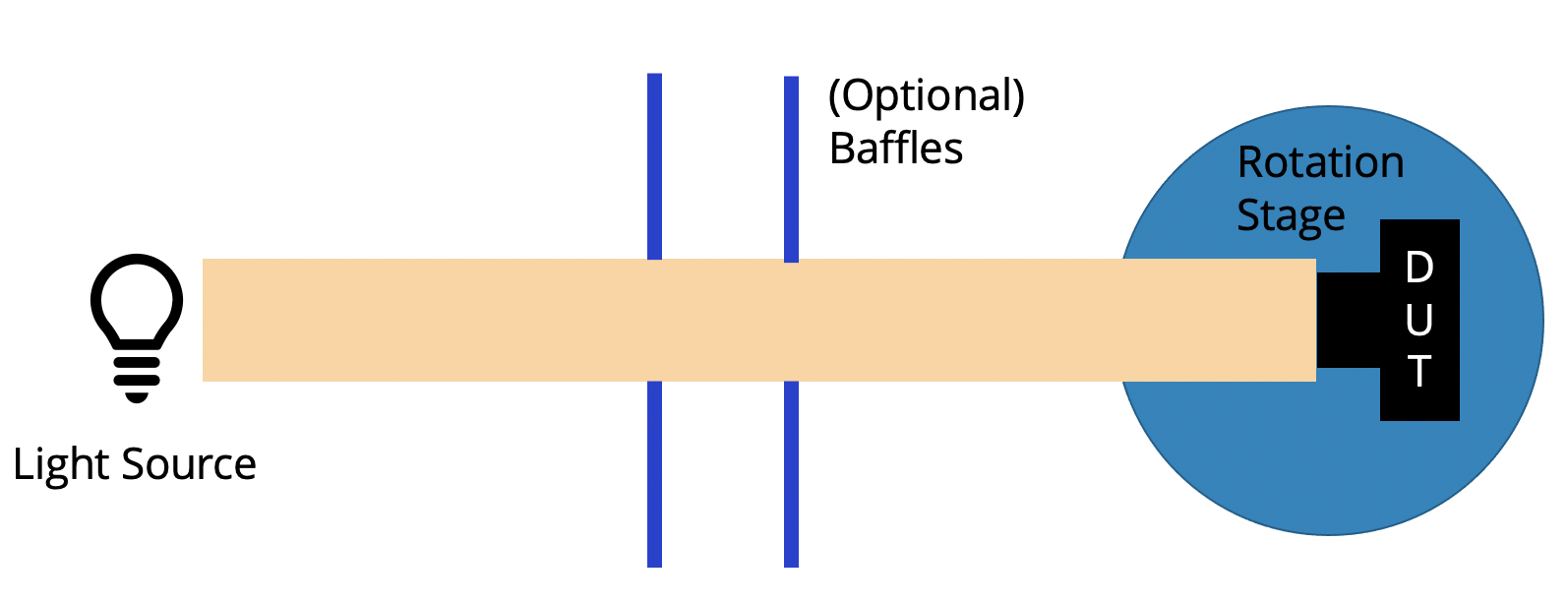
The basic stray light test setup uses a small bright light source in a black room. The camera (or light source) is mounted on a rotation stage to build up coverage. Optionally, baffling is placed between the light source and the camera.
Test Methodology
Initial Setup
- Start with a dark (black room) — any source of light will be noise to this test
- Setup the light source and
- Align the light to the DUT fixturing
Test Preparation
- Determine the test plan needed for the camera
- Light source
- Level
- Spectra
- Rotation
- Field angle limits
- Field angle delta
- Azimuth angle limits
- Azimuth angle delta
- Normalization method and configuration
- Camera settings
- Mode(s)
- Gain state
- Integration time
- Light source
- Integrate capture into the sample script
- Adjust the parameters of the sample script
Test Execution
- Setup for collection of the normalization data
- Collect the normalization data
- Setup for collection of the analysis data
- Collect the analysis data (this is done by running a capture script)
- Perform the analysis
Analysis
- Compute the normalization factor
- For each analysis image
- Identify if the direct image of the light source is present in the image
- If the light source is in the image, produce a mask of the direct image of the light source
- Compute the stray light metric image
- Compute any summary metrics
- Compute any meta-analysis (e.g., plots over field angle)
Understanding the Test
Thought Experiment
Assume you have an infinitely large, infinitely black room.
Question 1: If you take a picture in this room, what do you expect?
Show moreShow less
The expectation of taking a picture of a small bright light in a dark room is a dark image with a small bright area in it. That small bright area (the image of the light source is the designed optical path. This is NOT stray light, but rather the designed optical path. For this reason, the image of the light source should be masked out for stray light analysis.
Question 2: If you take a picture with a small, bright light source what do you expect?
Show moreShow less
Under the assumption that the background of the image is entirely zero, any values in the image above zero and outside the direct image of the light source are stray light. Note in practice, other factors (e.g., dark noise, blur) may be counted as stray light from this test.
Question 3: If the light source is out of the FOV, does you answer change?
Show moreShow less
If the light source is out of the FOV, we expect all zero responses, however, stray light may be measurable when the source is out of the FOV. Testing coverage should include samples from both inside and outside the FOV.
Question 4: If I change the level (e.g., lux, radiance, etc.) of the light source, what do you expect?
Show moreShow less
The level of the light source in the image is expected to be proportional to the level of the light source in the scene. To get more reproducible results, the test may normalize the level of the source.