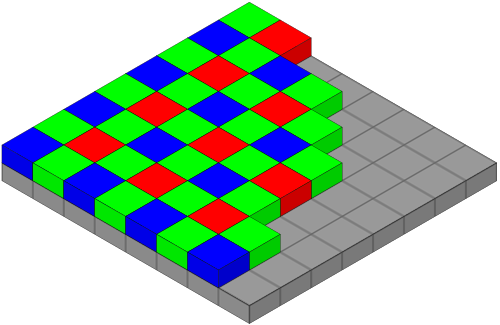
One might intuitively assume that a monochrome image sensor would have higher spatial resolution than a color sensor because there are 2-4x as many pixels sampling light projected on the focal plane as compared with a Bayer color sensor.
If you are working with a narrow-band light source, or you have bandpass filtered your light to a narrow band and your lens has been focused at the wavelength of your illumination or bandpass filter, this is true: your monochrome sensor will be sharper. This is bolstered by the narrow band light sources or bandpass filters often having a narrower range of frequencies than the filters in a color filter array.
However, if you are imaging under a broad-spectrum light source, the optical phenomenon of chromatic aberration, if present in your lens, can cause different wavelengths of light that are not as in focus (axial/longitudinal chromatic aberration), or spatially offset (lateral chromatic aberration) to be conflated with each other. In this case, the ability to demosaic/debayer the Bayer raw image and separate out the different color channels enables a color camera to potentially have higher MTF through:
For Lateral chromatic aberration, a color image processor can perform a lateral chromatic aberration correction, geometrically aligning the magnification of the different color channels with each other in an attempt to compensate for the lens' different magnification based on wavelength.
For Axial/Longitudinal chromatic aberration, by using the MTF of a luminance channel where the calculation favors the mid-frequency green wavelengths (~500-570nm), where your lens would ideally be focused, and have lower weights to the blue and red channels that are not in as good focus.
There are other advantages to utilizing monochrome sensors, such as no color moire or fringing and higher quantum efficiency / SNR, but the number of cases where the monochrome sensor is sharper are limited.