Overview
Flexible Image Transport System (FITS) is a file format designed for the archival transport and storing of scientific data [1, 2, 3]. The FITS standard [4] is developed by the International Astronomical Union (IAU) FITS Working Group [5]. It may contain multi-dimensional arrays (1D vectors, 2D images, 3D+ data cubes), tables containing information, headers to provide descriptive information about the data, and supports compression of the aforementioned data.
Interacting with FITS Files
The FITS file format is commonly used within the astronomy community; therefore, many software tools/applications already exist for analyzing FITS file image data.
Viewers
NASA GSFC maintains a list of FITS viewers [6].
SAOImageDS9
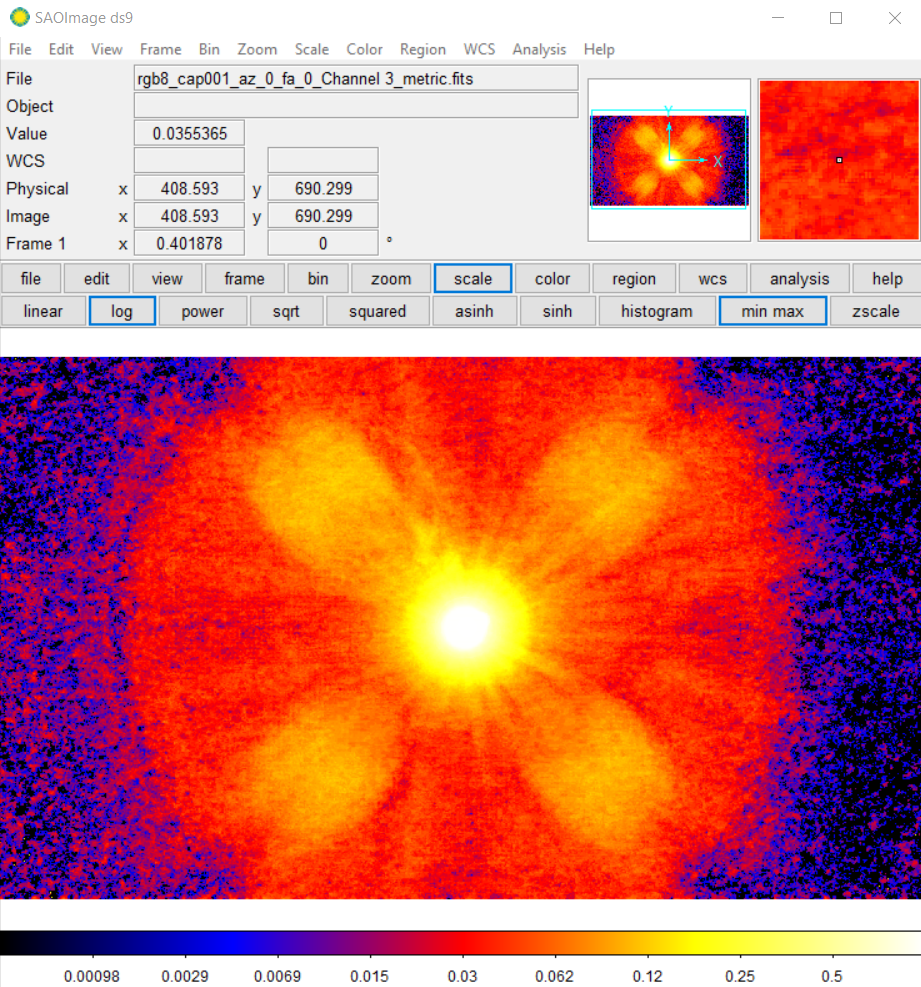
SAOImageDS9 [7, 8] is one example of a commonly-used, free FITS file-viewing application. SAOImageDS9 is used by amateur and professional astronomers alike, for analyzing scientific image data such as from the James Webb Space Telescope (JWST).
I/O Libraries
NASA GSFC maintains a list of FITS I/O Libraries that work with many common programming languages [9].
References
[1] https://fits.gsfc.nasa.gov/
[2] https://en.wikipedia.org/wiki/FITS
[3] https://www.loc.gov/preservation/digital/formats/fdd/fdd000317.shtml
[4] FITS Standard Document. https://fits.gsfc.nasa.gov/fits_standard.html
[5] IAU FITS Working Group. https://fits.gsfc.nasa.gov/iaufwg/iaufwg.html
[6] FITS Image Software Packages. https://fits.gsfc.nasa.gov/fits_viewer.html
[7] Joye, W. A., & Mandel, E. (2003). New features of SAOImage DS9. In Astronomical data analysis software and systems XII (Vol. 295, p. 489).
[8] SAOImageDS9. https://sites.google.com/cfa.harvard.edu/saoimageds9
[9] FITS I/O Libraries. https://fits.gsfc.nasa.gov/fits_libraries.html